FROM TUTANKHAMUN AT HIGHCLERE CASTLE TO ALBANIA: A JOURNEY THROUGH HISTORY, MEMORY AND FRIENDSHIP
FROM TUTANKHAMUN AT HIGHCLERE CASTLE TO ALBANIA: A JOURNEY THROUGH HISTORY, MEMORY AND FRIENDSHIP
Inspired by: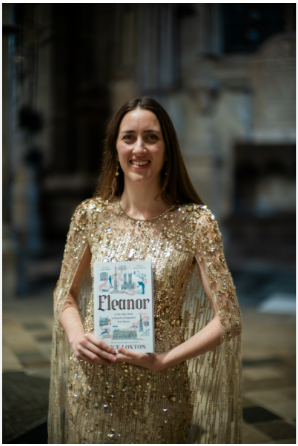
English historian Alice Loxton
Prologue
One evening, while browsing the internet, I came across a short historical reel by the British historian Alice Loxton. Standing in Egypt’s Valley of the Kings, she recounted one of archaeology’s greatest triumphs—the discovery of Tutankhamun’s tomb by Howard Carter in November 1922.
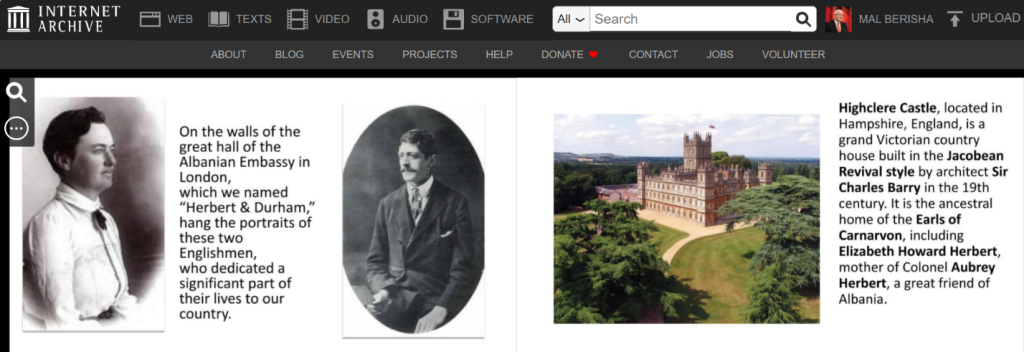
That reminded me that this extraordinary achievement had been made possible through the patronage of George Herbert, the 5th Earl of Carnarvon, whose ancestral home was Highclere Castle.
For millions of viewers, that was simply a story.
For me, it was the inspiration to tell another story.
The moment Highclere Castle was mentioned, my thoughts turned to another member of the Herbert family:
Colonel Aubrey Herbert, the English diplomat, parliamentarian, scholar, and humanitarian who became one of the greatest British friends the Albanian nation has ever known.
MY AMBASSADORSHIP TO THE UNITED KINGDOM
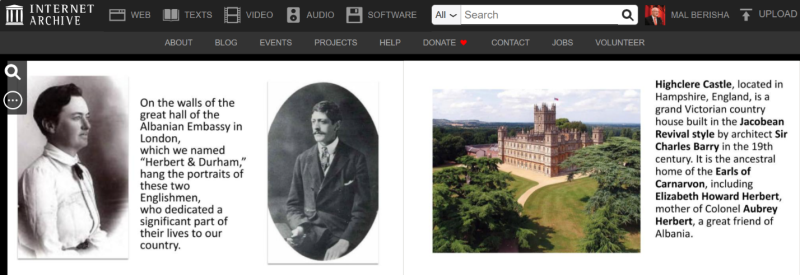
Alice Loxton’s presentation awakened memories of my own. During my years as Ambassador of Albania to the United Kingdom, I visited Highclere Castle and Pixton Park, met members of the Herbert family and others connected with their story, explored archives in Britain and the United States, and wrote extensively about Aubrey Herbert, his remarkable mother, Lady Carnarvon, his wife, Mary, his brother, Mervyn, his granddaughter, Mrs Mary Melotte, and her son, Colonel Edward Melotte, as well as the family’s enduring connection with Albania. I also presented this research at the National Library of Albania, various universities in Vienna, Geneva, USA, and other scholarly institutions.
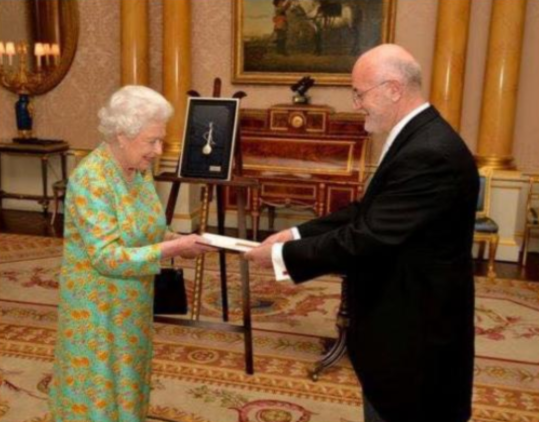
Watching her, I realised that two individuals from different generations—a British historian and an Albanian diplomat—had unexpectedly arrived at the same destination. She had reached Highclere through Egypt; I had reached it through Albania.
That coincidence revived a question that had long remained with me: How many visitors leave Highclere Castle knowing that, alongside its celebrated connection with Tutankhamun, it also occupies a distinguished place in the modern history of Albania?
This article seeks to answer that question.
It is neither a conventional biography nor a travel memoir. It is the story of a historical journey that led me from libraries and archives to Highclere Castle, Pixton Park, and the homes of the Herbert family, where history survives not only in documents but also in places, memories, and conversations.
For more than three decades, I have devoted much of my work to recovering the lives of Albania’s great foreign friends, such as Edith Durham, Charles Telford Erickson, Herman Bernstein, Margaret Hasluck, Benjamin Disraeli, Rose Wilder Lane, Lord Byron, Edith Pierpont Stickney, Melville Chater, Sir Noel Malcolm, and many others. Among them, Aubrey Herbert has always occupied a special place, not only because of what he did for Albania but because the friendship between his family and the Albanian nation endured long after his own lifetime.
Like Alice Loxton’s journey through the history of Egypt, this article begins at Highclere Castle.
Its destination is Albania.
Above all, it is the story of a remarkable friendship that history has preserved and that gratitude has never allowed to fade.
TWO HERBERT BROTHERS, GEORGE AND AUBREY—TWO LEGACIES
Every remarkable family leaves more than one legacy. The Herbert family is a striking example.
To the world, the name Herbert is inseparable from George Edward Stanhope Molyneux Herbert, the Fifth Earl of Carnarvon, whose patronage enabled Howard Carter to discover the tomb of Tutankhamun. That achievement secured his place among the great benefactors of archaeology and made Highclere Castle famous throughout the world.
Yet the Herbert family produced another figure whose legacy belongs not to ancient Egypt but to the modern history of Albania.
Colonel Aubrey Nigel Henry Molyneux Herbert, the Earl’s younger half-brother, devoted much of his life to the Albanian cause. While one brother helped reveal the treasures of an ancient civilisation, the other dedicated his talents, influence, and compassion to a young nation struggling to secure its independence and international recognition.
The contrast between the two brothers is striking:
One helped uncover the past, while the other helped shape the future. Both served humanity, each in his own way.
Raised in a family in which public service was regarded as both a privilege and a duty, Aubrey Herbert inherited a deep sense of responsibility. Gifted in languages, widely travelled, and intellectually curious, he developed an uncommon understanding of peoples beyond Britain’s borders. During his journeys through the Balkans, he encountered the Albanians and was deeply impressed by their courage, hospitality, and unwavering love of freedom.
What began as curiosity soon became conviction. Aubrey travelled widely throughout Albania, learned the language, met political leaders and villagers alike, and formed his own judgements rather than relying on reports written in distant capitals. His support for the Albanian national cause was founded on knowledge, personal experience, and genuine friendship.
During the critical years surrounding Albania’s independence, he became one of its most influential advocates in Britain. Through his parliamentary work, public advocacy, the founding of the Albanian Committee in 1912, and, together with Edith Durham, the establishment of the Anglo-Albanian Association in 1918, which still exists, in London, he helped ensure that the voice of a small nation was heard at a decisive moment in its history.
George Herbert is remembered throughout the world for his contribution to archaeology. Aubrey Herbert deserves to be remembered for a different but no less significant legacy: His enduring friendship with Albania.
The story that follows is that of an extraordinary Englishman and of the lasting bond that he and his family forged between Britain and the Albanian nation.
FOLLOWING COLONEL AUBREY HERBERT
For many years, Aubrey Herbert had been central to my research into Albania’s struggle for independence.
During my years as Albania’s Ambassador to the United Kingdom, although diplomacy occupied much of my time, I believed that an ambassador should also seek to understand the history and culture of the country in which he serves. Whenever my official duties allowed, I travelled to places associated with Britain’s great friends of Albania.
Gradually, two places came to matter more than any others: Highclere Castle, where Aubrey Herbert was born, and Pixton Park, where his remarkable life came to an end.
MY VISIT TO HIGHCLERE CASTLE
My visit was not part of an official programme. It was inspired by my gratitude as an Albanian. If Aubrey Herbert had devoted so much of his life to understanding my country, I felt I should make every effort to understand the world that had shaped him.
Before setting out, I revisited his biography, my research notes, and the valuable study by Bejtullah Destani and Jason Toms, Albania’s Greatest Friend. I wanted the journey to deepen my research rather than become simply another visit to one of England’s great country houses.
I expected neither sensational discoveries nor forgotten documents. My purpose was to understand the environment that had shaped that remarkable English gentleman.
That visit proved to be only the beginning. It would eventually lead me to Pixton Park, where Aubrey Herbert spent his final years; to Somerset, where I had the privilege of meeting members of his family; and to archives that revealed new insights into one of the most remarkable chapters in the history of Anglo-Albanian friendship.
My first visit to Highclere Castle took me through the peaceful countryside of Hampshire, a landscape of ancient woodlands, quiet villages, and carefully tended fields where England’s past seems to live naturally alongside the present.
As the castle’s towers emerged above the trees, I felt I was approaching far more than one of Britain’s great country houses. I was approaching the birthplace of Colonel Aubrey Herbert, who was born there on 3 April 1880 and whose life would become inseparably linked with Albania.
There is a profound difference between reading about a place and standing within it. Crossing the entrance hall, I paused for a moment, imagining the generations of the Herbert family who had walked those same corridors—statesmen, scholars, soldiers, and travellers whose sense of public duty helped shape Britain’s history. Among them was Aubrey Herbert.
As I moved through the castle, my attention was drawn less to its magnificent rooms than to the world that had formed his character. What values had he absorbed here? What inspired a privileged English aristocrat to devote so much of his life to the cause of a small Balkan nation from which he expected nothing in return?
Today, under the stewardship of Lady Fiona Carnarvon, Highclere Castle is celebrated throughout the world. Yet it also deserves to be remembered as the birthplace of a man whose influence extended to the London Conference, the League of Nations, and Albania’s struggle for independence.
Leaving the castle, I realised that I had discovered Aubrey Herbert’s origins, but not yet the man himself.
As my research continued, it became increasingly personal. Among those who generously guided me was Mary Melotte, a descendant of the Herbert family, whose warmth and willingness to share family memories enriched my understanding of Aubrey and of the family’s enduring friendship with Albania. Through her recollections and my continuing research, the more I learned, the clearer it became that Aubrey Herbert’s devotion to Albania sprang from the strength of his character. He believed that every nation, however small, deserved dignity and respect. He listened before he judged, and his commitment was founded on knowledge, friendship, and trust.
In 1923, the writings of Charles Telford Erickson, another great American friend of Albania, confirmed this impression. They revealed why Albanians placed such extraordinary confidence in Aubrey Herbert—a confidence that culminated in the remarkable proposal that he become King of Albania. Whether practical or not, that proposal reflected the deep respect he had earned through his integrity and selfless service.
By then, I knew my journey was far from over. To understand Aubrey Herbert fully, I had to follow him beyond Highclere—to Pixton Park, where the final chapter of his life unfolded.
MY VISIT TO PIXTON PARK, SOMERSET
AUBREY HERBERT AND THE ALBANIAN CROWN OF KINGDOM
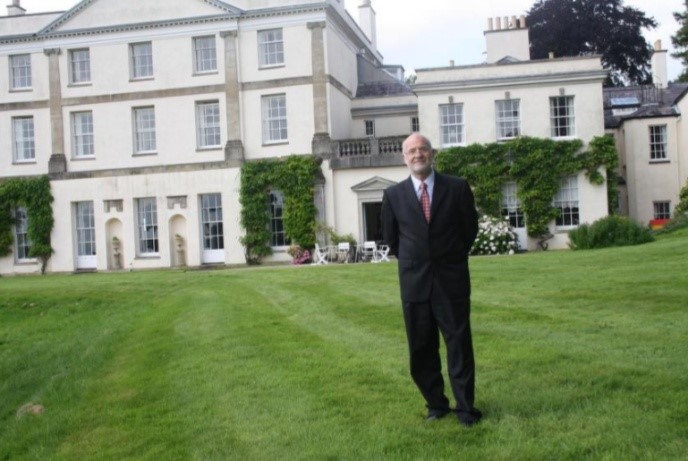
Pixton Park marked a new stage in my search for Aubrey Herbert. Unlike Highclere Castle, it attracts little public attention. Yet, for anyone wishing to understand Aubrey Herbert, it is perhaps the more significant place. It was here that he spent the final years of his life, surrounded not by the demands of public office but by family and close friends whose conversations often centred on Albania.
During my visit to Somerset with my wife, Donika Berisha, and my friend, the historian and diplomat Bejtullah Destani, we were warmly welcomed by Mary Melotte, Aubrey Herbert’s granddaughter. Her generosity transformed scholarly research into a deeply personal experience. She shared family memories and introduced us to documents preserved in the Somerset Library, confirming events that had long been known primarily through published sources.
Among the most valuable documents was evidence supporting Charles Telford Erickson’s account of the proposal that Aubrey Herbert become King of Albania. What some had regarded as little more than a romantic episode emerged as a well-documented historical reality.
Following Albania’s independence in 1912, the young state faced enormous challenges. Its leaders sought a constitutional monarch who would command both domestic confidence and international respect. Among the names considered, none inspired greater trust than Aubrey Herbert.
He sought neither power nor prestige. His reputation rested on years of devoted service, personal friendships, and an intimate knowledge of Albania acquired through travel, study, and direct experience. Charles Telford Erickson, who knew both Aubrey Herbert and the Albanian leadership personally, described these discussions with exceptional authority in his unpublished manuscript, Little Kingdom, What Next? His testimony makes it clear that the proposal reflected not political ambition but the profound confidence that Albanians placed in Aubrey Herbert’s integrity, judgement, and humanity.
That confidence was shared by Mehmet Konica, one of Albania’s most distinguished diplomats, who served as Albania’s Minister in London in the autumn of 1923, and one of Aubrey Herbert’s closest Albanian friends. Together with Erickson, he belonged to a circle of men united by their belief that Albania deserved a secure and honourable place among the nations of Europe.
Pixton Park also revealed another deeply moving chapter. Family tradition records that, as Aubrey Herbert realised that his life was drawing to a close, he entrusted to his mother the humanitarian work for Albania that had become so dear to him. Whether those words were spoken exactly as they were later remembered matters less than what followed.
LADY CARNARVON, ELIZABETH HERBERT: A MOTHER WHO FULFILLED HER SON’S MISSION
Lady Carnarvon faithfully carried forward her son’s humanitarian mission in Albania. She founded the British-Albanian Relief Committee and devoted herself to humanitarian work throughout the country. She established a medical mission in Vlora to combat malaria, bringing nurses from England, including Ruth Paddington. Through her brother, Sir Esme Howard, she secured assistance from the Rockefeller Foundation in New York. She also provided relief for Albanian refugees expelled from Kosovo by the Serbian authorities, founded the village of Herbert near Kavaja, built an elementary school that still stands today, and established the Herbert Library, whose collection later became an important foundation of Albania’s National Library and is now preserved in the Spiro Kolea Pavilion. Lady Carnarvon also introduced the game of tennis to Albania by bringing the country’s first tennis court and equipment.
After Lady Carnarvon’s death in Portofino in 1929, her work for Albania was continued by Aubrey Herbert’s widow, Mary Herbert, and by his brother, Mervyn Herbert, thus preserving the family’s remarkable commitment to the Albanian people. In recognition of her extraordinary humanitarian service, the Albanian newspaper Laboremus honoured Lady Carnarvon as “The Mother of the Albanian People”—perhaps the highest tribute a grateful nation could bestow upon a foreign friend.
Leaving Pixton Park, I realised that I was no longer tracing the life of one remarkable Englishman. I was discovering the story of a remarkable family whose friendship with Albania endured across generations. Highclere had revealed Aubrey Herbert’s beginnings; Pixton Park revealed his enduring legacy—one of the finest chapters in the long history of friendship between Britain and the Albanian nation.
A GOLDEN LEGACY RENEWED — COLONEL EDWARD MELOTTE
History sometimes reveals remarkable continuities across generations.
When Aubrey Herbert died in 1923, his friendship with Albania did not end. Lady Carnarvon carried forward his humanitarian mission, ensuring that the Herbert family’s bond with the Albanian people endured. Few could have imagined that, more than seventy-five years later, another member of the family would once again become part of Albanian history.
That moment came on 12 June 1999, when NATO forces entered Kosovo to help end one of the darkest chapters in the Balkans. Among the first British officers to cross the border was Colonel Edward Melotte, a descendant of the Herbert family.
For Albanians, this was far more than a coincidence. Nearly a century after Aubrey Herbert had defended their national cause through diplomacy, advocacy, and personal friendship, one of his descendants returned in British uniform as part of the international mission that helped restore peace and freedom to Kosovo. He later served as Military Attaché at the British Embassy in Tirana, further strengthening the long-standing connection between the Herbert family and Albania.
The circumstances were different. The values remained the same.
Across three generations, the Herbert family demonstrated an enduring commitment to justice, public service, and human dignity. Aubrey Herbert gave Albania his voice. Lady Carnarvon devoted herself to its humanitarian needs. Colonel Edward Melotte became part of the international effort that helped safeguard the freedom of Kosovo’s Albanians.
This continuity is the Herbert family’s golden legacy. That is the legacy of the Herbert family—a legacy that continues to inspire and deserves an honoured place in the shared history of Britain and the Albanian nation.
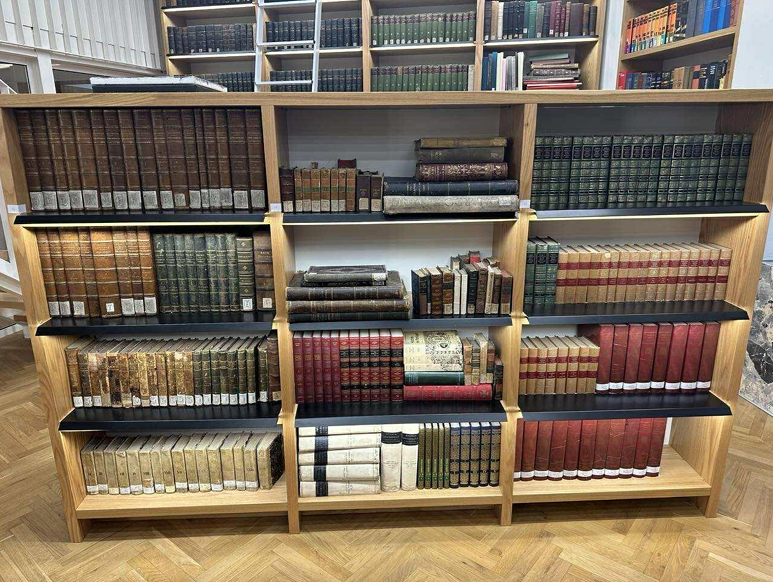
Herbert’s book in Spiro Kolea Public Library, Tirana
EPILOGUE
Returning to Highclere
When I first watched Alice Loxton’s short presentation from Egypt’s Valley of the Kings, I could never have imagined where it would lead me.
Her story celebrated one of history’s greatest archaeological discoveries. Mine became the story of one of Britain’s greatest friendships with the Albanian nation. Both journeys began at Highclere Castle. One led to the tomb of Tutankhamun; the other to the life of Colonel Aubrey Herbert.
Today, millions visit Highclere Castle because of Lord Carnarvon, Downton Abbey, and the discovery of Tutankhamun. Far fewer know that the same castle gave birth to a man who devoted his life to Albania; that his mother, Lady Carnarvon, transformed his ideals into humanitarian action; and that the Herbert family’s friendship with the Albanian people became one of the finest chapters in the history of Anglo-Albanian relations.
Aubrey Herbert left no golden mask, no royal tomb, and no archaeological treasures. He left something far more enduring: the gratitude of a nation.
Perhaps one day, those who visit Highclere Castle will remember not only the treasures discovered beneath the sands of Egypt, but also the extraordinary Englishman whose greatest legacy lives in the hearts of the Albanian people.
If this article helps restore that memory, then the unexpected journey that began with Alice Loxton’s brief historical presentation will have fulfilled its purpose.
As a former Ambassador of Albania to the United Kingdom, I can think of no more fitting conclusion than this:
“The friendship of the Herbert family with the Albanian nation remains one of the finest golden legacies in the history of relations between Britain and Albania.”
Mal Berisha
Montclair, New Jersey
11 July 2026
Note: To have a full idea of Colonel Aubrey Herberrt connection to Albania, please visit:
https://archive.org/details/aubrey-herbert-pp-soft-power-13-nentor-pdf/mode/2up